Thursday, November 8, 2018

Response to Slap


Nick Rowland's 2015 BAFTA nominated coming of age short film 'slap' is about a teenage boy that feels that wearing make-up and female clothing gives him a sense of freedom. however he is struggling with accepting it and so he hides it from his friends and his dad. training to box with his dad makes him scared to open up as his dad wants him to keep a tough boy look. 'Slap' confronts standards of masculinity in sports culture and how a young man attempts to construct his own sense of masculinity under single-minded gender-defined conditions.
When Connor is putting on make-up on in his room it is the first time that the audience sees him express his femininity. In the background we can see posters of women on his walls. The use of objectifying posters not only shows his appreciation for the female body but also shows his idealised self and what he aspires to look like. We can also assume that they are used to try and deceive his father into thinking that he finds the female body attractive and imply that he fantasises about women, much like other boys his age. However, they actually suggest that the he is unhappy with his masculine appearance and instead wishes to look more feminine, which he expresses through the posters and make-up as well as later on when he wears female atire. Therefore this reflects societies view that men must hide their emotions and stereotypical female characteristics because they do not fit into their masculine social category.




Thursday, October 4, 2018

Narrative structure theories

Vladimir Propp -
He founded the idea that a certain type of character was to be used in every narrative structure. He suggests that every fairy tale narrative structure specifically consists of eight characters: the villain, the dispatcher, the helper, the prize (e.g. princess), the father, the donor, the hero or victim/seeker hero and the false hero.
He noticed that often many folk type tales were similar in areas of the structure - he identified a theory about characters and actions as narrative functions.

Todorov -
He states that most stories and or plot lines follow the same pattern or path. There are 5 main steps in this pattern:
1. The Equilibrium - The first part has more of a positive tone, where most of the characters seem content with no obvious problem.
2. A Disruption - The second part is where something happens out of the ordinary that disrupts the happiness of the characters.
3. A Realisation - This part of the story is about the characters realising how serious the problem is, and therefore there is more panic/chaos.
4. Restored order - This is when the characters attempt to repair the damage and restore the problem.
5. Equilibrium again - The final part of the plot is when the problem is resolved and everything goes back to normality.


Levi Strauss -
He believed that the way we understood certain words depends not so much on the direct meaning they contain but more of how we understand the difference of the word and its opposite. A protagonist and antagonist, or the heroine and villain are both examples of binary opposites. Binary opposites are usually the basis of our understanding of a story as its a conventional narrative and enables an equilibrium.

Friday, September 28, 2018

Response to Over


Jorn Thelfall's 2015 short film is based on a true story about a man that fell to his death from an aeroplane as the wheels were extracted just before landing. It was made in remembrance of the man as he was immigrating over to England to meet some family for his birthday, and because of this, the tragic accident would have been easily forgotten.
It was set in a quite normal middle class area where nothing much happened, showing that for a moment, this event interrupted a normal lifestyle.
Personally, the way that the film was structured was very clever - the story went backwards so the beginning was the end and the end was what happened first. The audience viewing this would have been observing what is happening from an outside perspective rather than making any attachments towards any character. There is a lot of confusion and slight discomfort because of the slow pacing and extreme long takes whilst we focus more on working the story out.

Tuesday, September 25, 2018

Response to Operator

Image result for operator short filmNarrative: Caroline Bartleet's 'Operator' (2015) short film is about an emergency-service operator who tries to save a young mother and her son from a house on fire that they are trapped in. By the end of the story we see that this is her daily routine and so the there is almost a cyclical structure to the film.


Genre: suspense, shown well through the music but also the silence at the end. It is effective that the film is short and everything happens quickly as it feels more hectic and hooks the audience.


Representation: the audience can see the variety within the job. At the beginning we hear part of a conversation about someone calling in for a locksmith, while the main character that we focus on is trying to save a woman and her son from dying in a fire.
There is also a gender representation as there is a relatability between the operator and the mother, however the operator is a lot more calm and detached so that she can focus on the problem she is trying to solve. This shows the strength within women - the operator doesn't let her emotions get in the way and the young mother can be seen as strong as there is no mention of a male/father figure in the house, making her seem as brave and independent within the situation.

Audience: the audience was thrown into the situation quite  quickly without having much background information about the situation, and so we were quite emotionally invested as it was more stressful that the situation was life threatening for the woman.

Micro-elements: the majority of the time there were long takes with a side profile of the operator like, similar to the picture above. There is a contrasting silence at the end which is effective for the audience to take in what just happened before we see the operator move on to the next call. As some of the dialogue is hard to hear because of how frantic it is, we focus more on the music and the effect of it.


Friday, September 21, 2018

Response to Tight Jeans

Narrative:
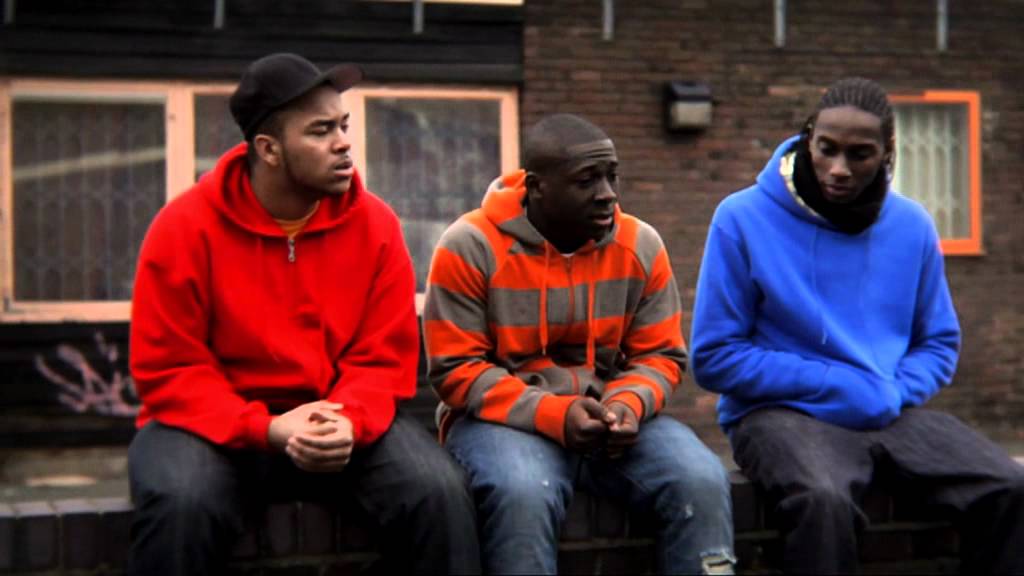
Destiny Ekaragha's short film 'Tight Jeans' (2008) is about three teen guys sitting on a wall having a casual and uncultivated three way conversation whilst waiting for their friend. They discuss the cultural stereotypes and reasons why they think that they can't/don't wear tight jeans.


Related image


Genre:
It is a light comedy that focuses on showing the 'normal' conversations between teens in a suburban setting.

Representation:
Destiny Ekaragha said in an interview that she wanted to show everyone how young males, especially of a different race, are misrepresented in films and so she wanted to bring across the more realistic and harmless situations/conversations.

Audience:
The audience might see the narrative as controversial because we might see this as another stereotype but also some people might disagree with how 'real' this conversation is.

Micro-elements:
There was mostly long shots with some slow zooms in and out focusing on the person that was talking to emphasise his story. The three different coloured hoodies contrasted to the surroundings, as it was quite bleak and simple and their hoodies were bright colours, making the audience focus more on the characters.


Thursday, June 28, 2018

Short films and new filmmakers

Why are short films a good thing for new filmmakers:
I think that because short films are more accessible for anyone to make, it would be easier for new filmmakers to stand out and to experiment before moving on to making big feature films. Furthermore, short film budgets are much smaller as there is simple editing involved with not many special effects, whereas with big blockbuster movies the budgets are much larger, ones that only an experienced and well-known filmmaker would be able to get. It also helps that the length of the film is short so it doesn't add too many complications - its a good way for new filmmakers to practice, gain more experience and to become more confident in filmmaking before becoming serious with making more time-consuming feature films.


Monday, June 25, 2018

Definition of a Short Film

What is a short film?
I think that any motion film that is about 40 minutes or less - so not long enough for a feature film - can be classified as a short film. The rest of the features that define a film, such as special effects, actors/ actresses, music etc. are not really as a bi importance to the definition of a short film, the main difference to compare a feature film and a short film is purely its length. Obviously,the budget is also important as no short film will be able to compete with the large budgets that blockbuster films bring to the film industry, but it is not as a big identifier like the length of the film.

Response to Echo

Lewis Arnold's 'Echo' is a short film about a teenage school girl who is seen playing out the same con at three separate points....